Implementation of the LSTM Model for Speech-to-Text Systems in the Recognition of the Walikan Language of Malang
Author's Country: Indonesia
DOI:
https://doi.org/10.36805/m0pcpk09Keywords:
Bahasa Walikan Malang, Speech-to-Text, Long Short-Term Memory (LSTM), Mel Frequency Cepstral Coefficients (MFCC), Word Error Rate (WER)Abstract
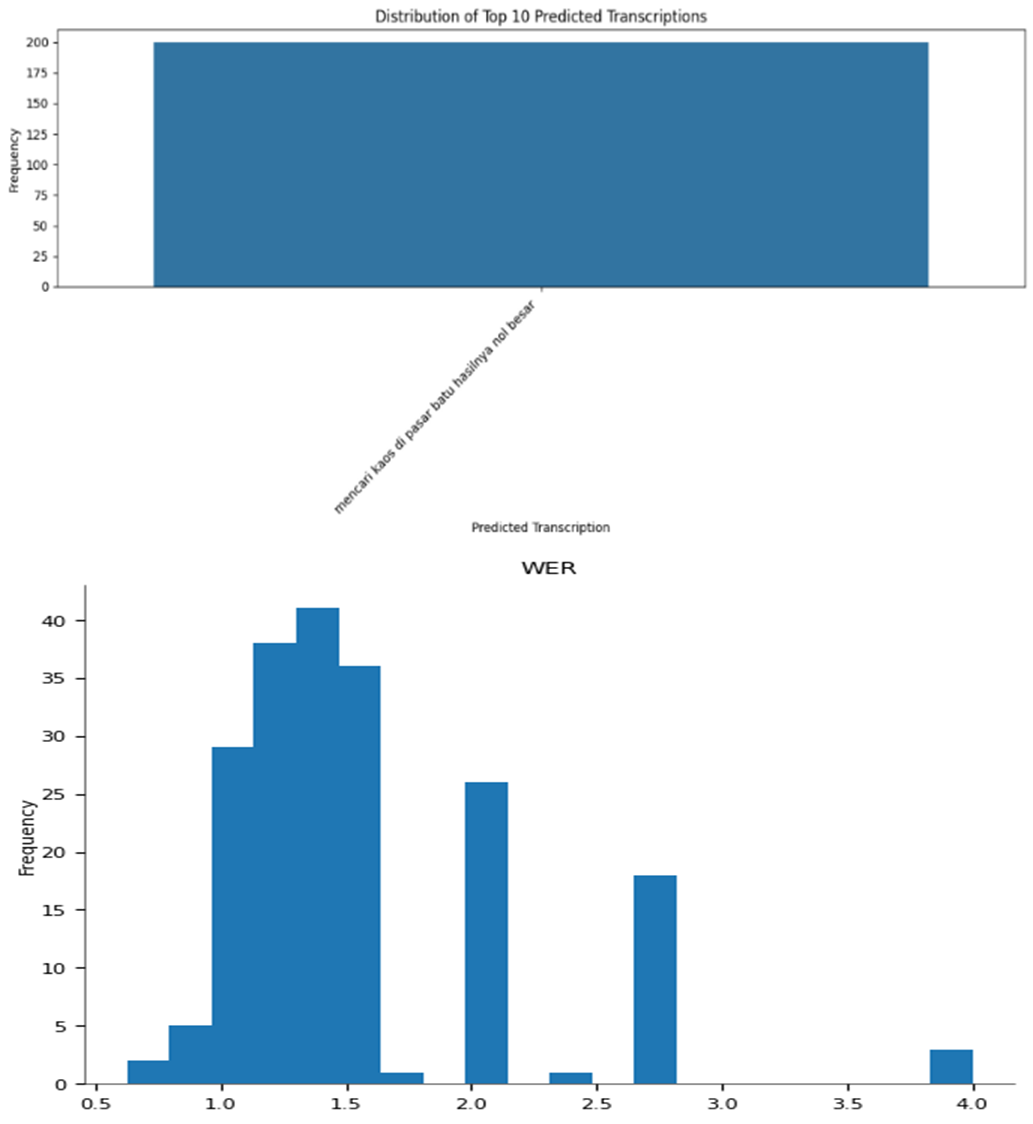
This study developed a Speech-to-Text (STT) system based on the Long Short-Term Memory (LSTM) model to recognize and convert speech in the Malang Walikan language into text. The Malang Walikan language has a unique linguistic structure in the form of word reversal, which poses a challenge in speech recognition. The data used consisted of 1,000 sentences collected from social media and direct recordings. The data was processed using Mel Frequency Cepstral Coefficients (MFCC) and then used to train the LSTM model.The system's performance was evaluated using the Word Error Rate (WER), Character Error Rate (CER), and Average Test Loss metrics. The best results obtained showed a WER value of 1.0 on a 699:300 data split, a CER of 0.78 on a 799:200 split, and an Average Test Loss of 11.0147 on a 299:700 split.The high Average Test Loss value indicates the model's difficulty in minimizing prediction errors, which may be caused by the model's mismatch with the data patterns or overfitting. To improve the model's performance, it is recommended to improve the quality of the training data, optimize the parameters, and apply regularization techniques.
Downloads
References
[1] T. P. Laksono, “Speech To Text Untuk Bahasa Indonesia,” Skripsi, 2018, [Online]. Available: https://dspace.uii.ac.id/handle/123456789/10756
[2] I Komang Setia Buana, “Implementasi Aplikasi Speech to Text untuk Memudahkan Wartawan Mencatat Wawancara dengan Python,” J. Sist. dan Inform., vol. 14, no. 2, pp. 135–142, 2020, doi: 10.30864/jsi.v14i2.293.
[3] L. Vinanda and M. J. Lelono, Aku, kami, dan mereka : mensyukuri perbedaan. 2013.
[4] N. Aini Lailla Asri, R. Ibnu Adam, and B. Arif Dermawan, “Speech Recognition Untuk Klasifikasi Pengucapan Nama Hewan Dalam Bahasa Sunda Menggunakan Metode Long-Short Term Memory,” JATI (Jurnal Mhs. Tek. Inform., vol. 7, no. 2, pp. 1242–1247, 2023, doi: 10.36040/jati.v7i2.6744.
[5] C. Ittichaichareon, S. Suksri, and T. Yingthawornsuk, “Pengenalan Ucapan menggunakan MFCC,” pp. 28–29, 2012.
[6] Riakesdas, “Bab 1 pendahuluan,” Pelayanan Kesehat., no. 2018, pp. 3–13, 2018, [Online]. Available: http://repository.usu.ac.id/bitstream/123456789/23790/4/Chapter I.pdf
[7] W. Gunawan, H. Sujaini, and T. Tursina, “Analisis Perbandingan Nilai Akurasi Mekanisme Attention Bahdanau dan Luong pada Neural Machine Translation Bahasa Indonesia ke Bahasa Melayu Ketapang dengan Arsitektur Recurrent Neural Network,” J. Edukasi dan Penelit. Inform., vol. 7, no. 3, p. 488, 2021, doi: 10.26418/jp.v7i3.50287.
[8] J. Oruh, S. Viriri, A. Senior, and D. A. N. Lainnya, “Memori Jangka Panjang Jangka Pendek Saraf Berulang Jaringan untuk Pengenalan Ucapan Otomatis,” vol. 10, pp. 30069–30079, 2022.
[9] R. G. Gunawan, Erik Suanda Handika, and Edi Ismanto, “Pendekatan Machine Learning Dengan Menggunakan Algoritma Xgboost (Extreme Gradient Boosting) Untuk Peningkatan Kinerja Klasifikasi Serangan Syn,” Jurnal CoSciTech (Computer Science and Information Technology), vol. 3, no. 3, pp. 453–463, Dec. 2022, doi: 10.37859/coscitech.v3i3.4356.
[10] M. Zlobin and V. Bazylevych, “Bayesian Optimization For Tuning Hyperparametrs Of Machine Learning Models: A Performance Analysis In Xgboost,” Computer systems and information technologies, no. 1, pp. 141–146, Mar. 2025, doi: 10.31891/csit-2025-1-16.
[11] P. Fajar and Y. I. Aviani, “Hubungan Self-Efficacy dengan Penyesuaian Diri: Sebuah Studi Literatur,” vol. 6, no. 1, pp. 2186–2194, 2022.
[12] A. Akbar et al., “Pelatihan Dan Pengembangan Sdm Dalam Perspektif Ilmu Manajemen: Sebuah Studi Literatur,” 2023.
[13] U. Mufidah and M. Siahaan, “Perancangan Aplikasi Perbanndingan Harga Produk (Historical Data) Menggunakan Teknik Scraping Web,” 2021.
[14] M. Rizqi, A. Rustiawan, and P. T. Prasetyaningrum, “Analisis Sentimen Terhadap Klinik Natasha Skincare di Yogyakarta Dengan Metode Google Review,” Journal of Information Technology Ampera, vol. 5, no. 1, pp. 2774–2121, 2024, doi: 10.51519/journalita.v5i1.556.
Downloads
Published
Issue
Section
License

This work is licensed under a Lisensi Creative Commons Atribusi-BerbagiSerupa 4.0 Internasional.